


BISFF2025 | Correspondence 通信计划057:Dreyer’s Mother 德莱叶之母
已更新:3月21日
BISFF Correspondence 通信计划
This program involves conducting brief email interviews with the directors of the international films featured in the festival, in lieu of the traditional Q&A session that follows the screenings. Through this program, we hope to provide a platform for filmmakers to discuss their work and share their insights with our audience in China.
为了跨越种种障碍,开辟更多交流空间,我们设置了“BISFF Correspondence 通信计划”,对部分国际单元的参展作者进行系列访谈,这些访谈将在作品放映后发布在联展各个媒体平台。

Dreyer's Mother|德莱叶之母
Nuria Cubas 努丽娅·库巴斯
2025|0:20:55|Spain|Spanish, English|World Premiere
Director: Nuria Cubas
Interviewer & Translator: Zou Xiaofan
Coordinator & Editor: Suliko
导演:努丽娅·库巴斯
采访、翻译:邹筱帆
统筹、编辑:苏丽珂
Q1: In the film, you center on Josephine Nilsson, the biological mother of Carl Theodor Dreyer, a woman whose story has long been hidden in history. What drew you to tell her story, and what kind of feminine experience did you hope to rediscover through her perspective?
A1: I first read about Josephine Nilsson many years ago, in an article about the film Gertrud on Jonathan Rosenbaum's blog. At the time, I didn’t know that Dreyer, a filmmaker who fascinated me, was adopted and therefore I was also ignorant of the story of his biological mother, Josephine. Rosenbaum gave just a few biographical details about her and mentioned something that caught my attention: it is known that when Josephine managed to leave her son in the care of the Dreyer family, after several trips to Copenhagen and when the child was about a year old, she was pregnant again, and Rosenbaum speculated that ‘perhaps it was by another man’. Calculating the timing of her first pregnancy, considering that she was a 33-year-old woman (i.e. mature for the 19th century) and a housekeeper in rural Sweden, the possibility that she had several ‘lovers’ suddenly seemed implausible to me. This idea together with the lack of information, led me to begin speculating about Josephine Nilsson's possible relationship with Dreyer's biological father, Jens Christian Torp, the owner of the farm where she worked and, in my imagination, her only lover. Somehow, twisting Rosenbaum's speculation, I thought, ‘She was pregnant again, perhaps by the same man,’ and that's where the story of an unstoppable and destructive desire came in.
What is interesting about this hypothesis is that the character's destruction has nothing to do with desire itself, but rather with the fact that her desire, and the desire of women who do not have access to contraceptives or safe abortion, is associated with motherhood. I still believe that Josephine Nilsson's decision to terminate her second pregnancy is directly linked to the certainly traumatic and lonely experience she went through for a year, searching for someone to care for her “illegitimate” child. She died because her desire and sexuality was inevitably linked to motherhood, and there are many circumstances in which motherhood still is a state of absolute vulnerability for women.

Dreyer's Mother, Nuria Cubas, 2025
Q2: The whispering voice throughout the film feels both dreamlike and haunting. Where does this voice come from? Do you see it as the character’s inner monologue, or as a more abstract consciousness that exists within the film itself?
A2: That voice is things that have been said or thought. We included the voice-over in the final stage of the sound design. I wrote the text as if they were intrusive or recurring thoughts belonging to the two lovers, things they have said to each other or thought about each other. They are words that are in their memory, but also in the memory of the spaces they move through, as if the walls were repeating aloud the things they have said to each other.
Q3: In one whisper, we hear “I am that saint and so are you,” referring to Saint Sebastian. This line carries strong symbolism. What kind of female condition or inner state did you wish to evoke through this invocation?
A3: In Catholic culture, Saint Sebastian is a well-known martyr who was condemned to death for defending Christianity. He was tied to a pole and shot with arrows, but they failed to kill him. Saint Sebastian is therefore depicted in art as a naked man, tied up, pierced by several arrows and with his eyes open, representing pain that does not kill you. I have always liked Saint Sebastian; I find him very erotic. In the film, I was interested in representing this desperate desire through the image of Saint Sebastian: you are pierced by arrows, but you are still alive. Josephine is exactly that, she is going through an ordeal, struggling between her desire and the motherhood that comes with it, but she is very much alive inside.
Q4: In the middle of the film, after the protagonist runs through the forest, she sits face to face with a skeleton, an image that evokes both contemplation and confrontation. How do you interpret this moment? What kind of emotional or narrative turning point does it represent within the film?
A4: Death is present throughout the film from the very beginning when the child's voice tells us that Josephine is going to die. Her situation is truly untenable, and in that scene in the forest, we know that Josephine is in danger. Her desire for that man and wanting to live their sexuality openly, puts her in a critical position. It is a question of gender and social class. There is a popular saying in Spanish that is found as an epitaph on some ancient gravestones: ‘As I see you, I saw myself; as you see me, you will see yourself.’ It is a warning to the living. Josephine's encounter with the skull has the same intention: she is alive, but she will not be able to escape death.
Q5: Throughout the film, there is a tension between motherhood and female desire. Do you see Josephine’s attempt to escape the confines of motherhood as a form of resistance against social or religious authority?
A5: Sexuality and motherhood are closely linked in women, especially if we do not have access to contraceptives or safe abortion services. I think that Josephine, as a character, is not trying to resist any established order, she just wants to live out her desires and her sexuality. She wants to live and enjoy life, and motherhood is a consequence that she must bear alone. Dreyer grew up hearing that his mother had abandoned him, but no one seems to have reproached his father for considering him illegitimate and washing his hands of him.
I have always seen Josephine as a very lively character who knows what she wants and does what she can within her circumstances. She accepts her desires and her sexuality, and she also accepts responsibility for her son, ensuring he has a good home. She never really abandoned him, as she paid alimony to the Dreyer family until the day she died. And finally, she is intelligent enough to see that it makes no sense to have another child in those circumstances. If her actions challenge social or religious authority, it is because she recognizes her rights, even if no one else saw them yet.
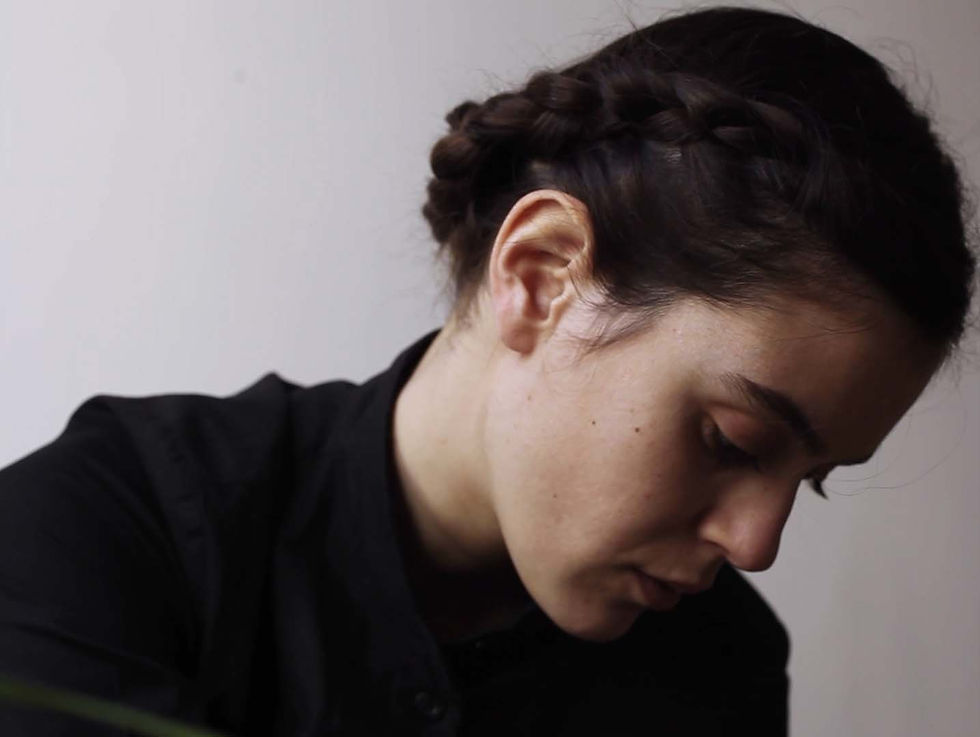
Dreyer's Mother, Nuria Cubas, 2025
Q1: 影片以卡尔·西奥多·德莱叶的生母约瑟芬·尼尔森为中心,重新注视一段在历史中几乎被遗忘的女性故事。请问是什么促使您选择以她为主角?您希望通过她的视角重新发现怎样的女性经验?
A1: 许多年前,我第一次了解到约瑟芬·尼尔森的名字,是在影评人乔纳森·罗森堡的博客上读到一篇关于电影《葛楚》的文章。那时,我并不知道我所钟爱的导演德莱叶其实是被收养的,也更不了解他生母约瑟芬的故事。罗森堡在文中虽然只给出了关于这位母亲的一些简单的生平细节,却提到了让我印象极深的一点:据说当约瑟芬在多次往返哥本哈根之后,终于把大约一岁的孩子托付给德莱叶一家的那段时间,她已经再次怀孕。而罗森堡推测,“或许那孩子的父亲是另一个男人”。可当我仔细计算她第一次怀孕的时间,又想到她当时是一位三十三岁、这样一个在十九世纪已算相当成熟的瑞典乡村女佣时,所谓“情人众多”的说辞在我看来忽然变得不太符合情理。加上相关资料的匮乏,这让我开始推测约瑟芬与德莱叶生父延斯·克里斯蒂安·托普之间可能存在的关系。托普是她工作地的农场主人,在我的想象里,他是她生命中唯一的爱人。于是,我推翻了罗森堡的推测,反过来想“也许她再次怀孕的孩子,仍然是属于同一个男人的”。就这样,一个关于无法克制的欲望最终导致毁灭的故事,在我心中慢慢成形。
这一假设的有趣之处在于,这个人物的毁灭与其说源于其欲望本身,不如说源于这样一个事实:她的欲望,以及那些无法获得避孕措施和安全堕胎服务的女性的欲望,与母职紧密相连。我依然坚信,约瑟芬·尼尔森终止第二次妊娠的决定,与她历经一年四处寻人抚养她的“私生子”时所承受的创伤与孤独直接相关。她的死亡源于其欲望与性别总是不可避免地与母职捆绑,而在诸多情境中,母职对女性而言仍是一种绝对脆弱的生存状态。
Q2: 影片中的呢喃声时而如梦似幻,时而近乎召唤。请问这声音来自何处?它是人物的内心独白,还是您为影像赋予的一种更抽象的意识?
A2: 那些声音承载着他们曾经说出或思索过的话语。我们在声音设计的最终阶段才选择加入画外音旁白。我撰写文本时,将其构思为属于两位恋人侵入性或反复出现的思绪,是那些他们互相说过的话语,或是对彼此的思念。这些话语既存在于他们的记忆中,也铭刻在他们穿行的空间记忆里,仿佛墙壁正大声重复着他们彼此倾诉过的点滴。
Q3:片中出现了关于圣人圣塞巴斯蒂安的呢喃:“I am that saint and so are you.” 这一句极具象征性。您希望通过这段呼唤呈现怎样的女性处境或精神状态?
A3: 在天主教文化里,圣塞巴斯蒂安是位著名的殉道者,他因捍卫基督教信仰而遭处决。他被绑在柱子上射满箭矢却未死,因此艺术作品中常将他描绘成赤身裸体、浑身插满箭矢、双眼睁开的形象,象征着“痛楚却不致死”的状态。我向来钟爱圣塞巴斯蒂安,觉得他极具情欲魅力。影片中我试图通过圣塞巴斯蒂安的形象呈现这种绝望的渴求:身中箭矢却依然活着。约瑟芬也正是如此,她正经历磨难,在欲望与随之而来的母职之间挣扎,但内心依然鲜活如初。
Q4:影片中段,女主角在树林奔跑后,与骷髅面对而坐的画面令人印象深刻,似乎同时象征着一种注视与思索。请问您如何理解这一幕?它在影片中代表了怎样的情感或命运转折?
A4:死亡自影片伊始便如影随形,当孩童的声音告诉我们约瑟芬将要死去时,这一命题便已揭开。她的处境堪忧,在森林里的那一幕,我们便知她身陷险境。她对那个男人的渴望,以及想要公开表达自己性欲的愿望,使她陷入危急境地。这是一个关乎性别与社会阶层的命题。西班牙有句流传甚广的箴言,常见于古墓碑铭文:“我见你如见己身;你见我终将遇己。”这是对生者的警示。约瑟芬与骷髅的相遇同样暗藏深意:她虽尚在人世,却终难逃死亡的宿命。

Dreyer's Mother, Nuria Cubas, 2025
Q5:从故事到影像,影片不断回望“母职”与“女性欲望”之间的冲突。您是否认为约瑟芬试图脱离母职束缚的行为,也是一种对社会结构或宗教权威的反抗?
A5:女性的性与母职往往紧密相连,尤其是在我们无法获得避孕措施或安全堕胎服务的情况下。我认为约瑟芬这个角色并非在试图反抗既定秩序,她只是想依循自己的真实欲望和性别身份活出自我。她想活着,并享受人生,而母职是她必须独自承担的后果。德莱叶从小就听闻母亲抛弃了他,但似乎无人谴责其父将他视为私生子并弃之不顾的行为。
我始终认为约瑟芬是个非常有生命力的角色,她清楚自己想要什么,并在所处境遇中尽力而为。她坦然接受自己的欲望与性别,同时也承担起对儿子的责任,确保他拥有一个良好的生活环境。她从未真正抛弃过他,因为直到生命最后一刻,她仍在向德莱叶一家支付抚养费。最后,她足够明智,明白在那种境遇下再要孩子毫无意义。若她的行为挑战了社会或宗教权威,那是因为她认识到自己的权利,即便当时无人认同。
About the Artist 艺术家简介
Nuria Cubas (Madrid, 1984) is a filmmaker and programmer. Since 2010 she has made numerous works in video and Super8. Some of her most outstanding works are her short films Viernes 4, Martes, 8 (2013), Il Gattopardo (2022) and the performative film Puertas que se abrían y se cerraban (2024). His work has been shown in exhibition spaces such as ECOH (Mexico City), Tabakalera (San Sebastian) and Pickpocket (Lisbon) and at festivals such as Lima Independiente (Peru), Zinebi (Spain), Antofacine (Chile) and Habitar el Cine (Venezuela). In 2015 he co-founded FILMADRID International Film Festival, a festival he has directed ever since.
努丽娅·库巴斯(1984 年生于马德里)是一位电影人与选片人。自 2010 年起,她以录像与超 8 为媒介,创作了多部影像作品。其代表作包括短片《星期五 4,星期二 8》(Viernes 4, Martes, 8, 2013)、《豹》(Il Gattopardo, 2022),以及行为影像作品《开合之门》(Puertas que se abrían y se cerraban, 2024)。库巴斯的作品曾在多个展览与影像空间放映,包括墨西哥城 ECOH、圣塞巴斯蒂安 Tabakalera 当代文化中心,以及里斯本 Pickpocket 空间,并入选秘鲁利马独立电影节(Lima Independiente)、西班牙毕尔巴鄂国际纪录与短片节(Zinebi)、智利安托法加斯塔国际电影节(Antofacine)等影展。2015 年,库巴斯共同创办了马德里国际电影节(FILMADRID International Film Festival),并自创办以来持续担任艺术总监。
▌more information: https://www.bisff.co/selection/dreyer's-mother


